Introduction:
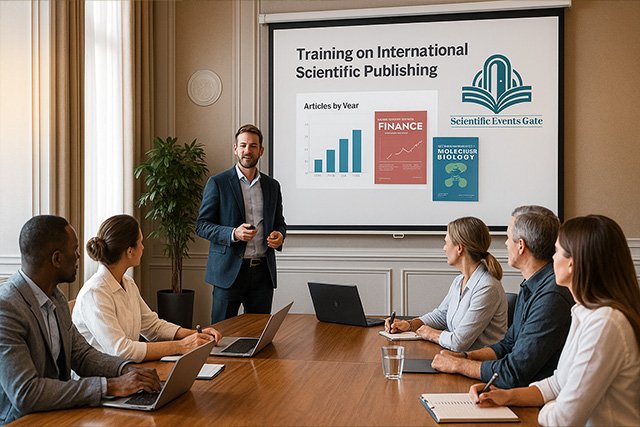
The International Scientific Research Publishing Course is a fundamental training program for researchers and postgraduate students across various disciplines. Its primary aim is to develop their skills and empower them to publish their work in reputable international scientific journals. International publishing plays a pivotal role in fostering the exchange of knowledge and expertise among researchers worldwide, enhancing their academic impact.
During this course, participants will learn how to select suitable journals for their research, understand the importance of originality and innovation in scholarly work, and explore strategies to avoid plagiarism while ensuring content quality. They will also receive practical guidance from experts in scientific publishing to increase their chances of acceptance and build professional networks with peers in their field.
Course Content:
Essential precautions for international scientific publishing.
Types of publishing: local, international, and predatory — and how to distinguish between them.
Publishing in local journals: importance, advantages, disadvantages, and how to find them.
Publishing in international journals: advantages and disadvantages.
Understanding databases, their types, and the differences between databases, publishers, and journals.
Differences between Scopus, Web of Science, and ScienceDirect.
Practical application using smart tools (Scopus.ai, ScienceDirect.ai).
Journal metrics (CiteScore, Impact Factor, SJR, ISNP).
Determining a journal’s ranking (Q).
How to choose the right journal and follow its submission guidelines.
Steps for submitting a manuscript and tracking its status.
Common reasons for article withdrawal or rejection, and how to avoid them.
The Egyptian Knowledge Bank publishing agreement: terms and benefits.
Learning Outcomes:
By the end of this course, participants will be able to:
Understand the fundamentals of local and international scientific publishing.
Recognize the importance of publishing and how to select suitable journals.
Differentiate between local and international journals.
Assess journal quality using metrics such as CiteScore, Impact Factor, SJR, and ISNP.
Select the right journal for their research.
Prepare manuscripts for publication.
Submit research articles and track progress post-submission.
Avoid common mistakes in publishing.
Benefit from the Egyptian Knowledge Bank publishing agreement.
Enhance their overall scientific publishing skills.
Trainer:
Eng. Ibrahim Ashour Ibrahim Abdulwahab – Arab Republic of Egypt
An expert in artificial intelligence and digital transformation, Eng. Abdulwahab is the Head of the Scientific Research Department at the International Board of Training, Founder and Director of the Future Scientists Platform, and a seasoned presenter of lectures and seminars at local and international scientific conferences. He is a member of the International Board of Training, the IFAD Academic Research Platform, and the Entrepreneurship Club at Cairo University.
Target Audience:
Postgraduate students (Master’s and Ph.D.) from all disciplines seeking to enhance their research skills.
Researchers and academics.
University faculty members.